
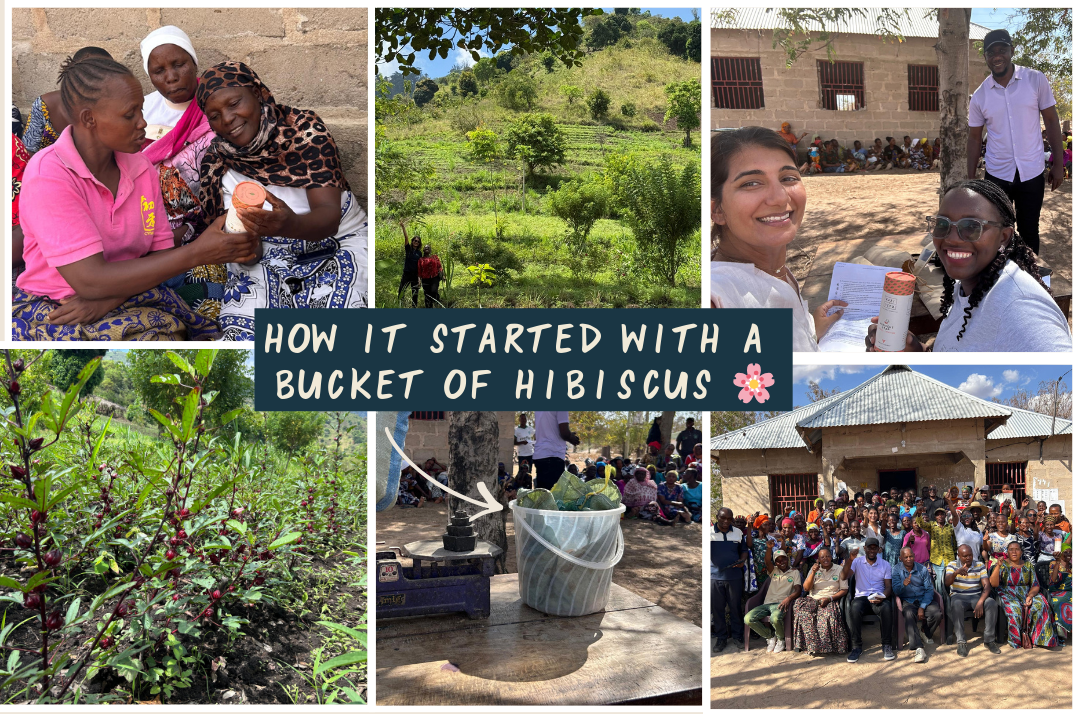
It all started with a bucket full of flowers.
A transparent tub, set on the ground in front of us, filled to the top with deep red rosella hibiscus petals. Behind it stood a group of over 200 women, colorful, excited, young and old, with confidence and agency, some with babies on their backs.
Our team had traveled by train for four hours from Dar es Salaam to Dodoma - a smooth journey through lush, fertile Morogoro, ancient baobab trees across the plains, and into the wide heart of central Tanzania. With me were Stadia (Production Supervisor), Geofrey (Field Officer), and Mtama (Organic Trainer). We had been anticipating this visit for weeks.
From Dodoma, we drove to Ilindi, a small and remote village in Bahi District, overlooking a vast seasonal lake. It felt almost like Mars - houses scattered across open plains, the air wide and still, as if tumbleweeds might roll through. As the landscape shifted outside the window, I felt that familiar mix of excitement and responsibility - the kind you feel when you know something important is about to begin.
When we arrived at the village council, we were greeted by a large, excited crowd of farmers - all ready to engage. Standing there, I felt both small and deeply privileged - welcomed into a place that had been quietly growing these flowers long before we arrived.
 We sat outside the village council building, finding shade under nearby trees. We introduced Kazi Yetu as a tea and botanicals company based in Dar es Salaam, working with farmers across Tanzania and increasing market access to over 13 countries. We spoke about our focus on regenerative agriculture, and on improving livelihoods, especially for women. We shared our plans to invest in solar dryers and post-harvest equipment to help improve quality, reduce waste, and secure better pricing for farmers.

After listening, the farmers spoke with one voice: they were ready to work with Kazi Yetu.
They told us how they usually sell to middlemen - never knowing when they will arrive, how much they will pay, or where the hibiscus eventually ends up. The idea of selling directly to a customer, at a fair and transparent price, lit up the room. It meant dignity. It meant predictability. It meant agency.
Then came the discussion about price.
“So, what is your expected price per kilogram of hibiscus?”
That’s when they brought out the bucket.
Their norm is simple: fill a bucket, sell a bucket. No scales. No metrics. Just a container full of flowers. Our team looked at each other and smiled at the elegance of it. Practical. Efficient. Human.
We paused the meeting and Geofrey ran across the road to find a weighing scale - an old one, the kind that uses heavy copper bricks as weights. Together with the farmers, we weighed the bucket.
1.75 kilograms.

Geofrey stood up and said,
“With this exercise, you now know that with Kazi Yetu, you can rely on transparent pricing, clear volumes, and an equitable partnership.” I remember thinking: this is exactly where Kazi Yetu is meant to be - not in boardrooms, but here, under trees, translating dignity into systems.
The farmers nodded. They understood exactly what that meant. There was a lump in my throat when they said yes. Not because of supply, but because of trust.
Hibiscus grows beautifully in Tanzania during the main rainy season in April. We sourced organic, local seedlings and distributed them among farmers in Bahi and Bumbuli - where smallholders already grow peppermint, ginger, lemongrass, and other herbs and spices.
But we don’t just give seeds.
We train farmers in regenerative agriculture - how to prepare living soil with compost and organic matter, how to sow in harmony with the rains, how to intercrop hibiscus with food crops and trees, how to protect moisture in the ground, and how to let the land regenerate rather than deplete. The goal is simple: healthier soil, stronger plants, better yields, and farms that will still be fertile for the next generation.

Where hibiscus was once dried on bare ground or tarpaulin sheets, we are now installing solar dryers - improving hygiene, quality, shelf life, and income. We’ve applied for organic certification so these farmers can access higher-value markets and earn more from the same hard work.
And now, we wait for the season to begin.
Every cup of hibiscus in our teas will carry this story - of women, buckets, trains, sunlight, soil, and a shift from uncertainty to partnership.
This is how ingredients become impact.

Taste it for yourself.
Shop our Hibiscus Star and be part of the story that began with a single bucket of flowers.


Leave a comment
This site is protected by hCaptcha and the hCaptcha Privacy Policy and Terms of Service apply.